The HOTMA Compliance Cliff: Why Affordable Housing's Best Year on Paper Could Stall on Talent
Affordable housing just received its biggest production tailwind in a decade and another moving compliance target at the same time. The One Big Beautiful Bill Act dramatically expanded LIHTC capacity while HUD's April 13, 2026 notice reset the rules for interim reexaminations again. The result is a compliance staffing cliff that could become the bottleneck for the new pipeline.
The supply event
The One Big Beautiful Bill Act, signed July 4, 2025, permanently expanded the Low-Income Housing Tax Credit. Projects placed in service after December 31, 2025 qualify for the 4% credit with only 25% of aggregate basis financed by private activity bonds, down from 50%. The 9% allocation pool grew by a permanent 12% on top. Novogradac estimates the package will finance 1.22 million additional affordable rental homes over 2026 through 2035 (Novogradac, June 2025). More than 20 states had been at or near their bond cap. The 25% test could roughly double 4% deal capacity in those bond-cap-constrained states. Standard LIHTC construction-to-lease-up timelines put those units online 18 to 24 months from groundbreaking, which means the compliance hiring window is open today.
A clarification on scope. HOTMA's direct authority covers HUD Multifamily and Public Housing programs, not standalone LIHTC deals administered by the IRS and state HFAs. The operational impact is much more direct on layered properties: LIHTC plus project-based Section 8, HOME, HTF, or PBV. That layered category is where most affordable units actually sit, and where compliance complexity is rising fastest.
That is the supply story. The compliance story is moving in a different direction.
A moving target, again
The Housing Opportunity Through Modernization Act final rule went into effect January 1, 2024. Full compliance has moved twice since: from July 2025, to January 1, 2026, and now to January 1, 2027 (HUD Notice H 2025-07, December 2025).
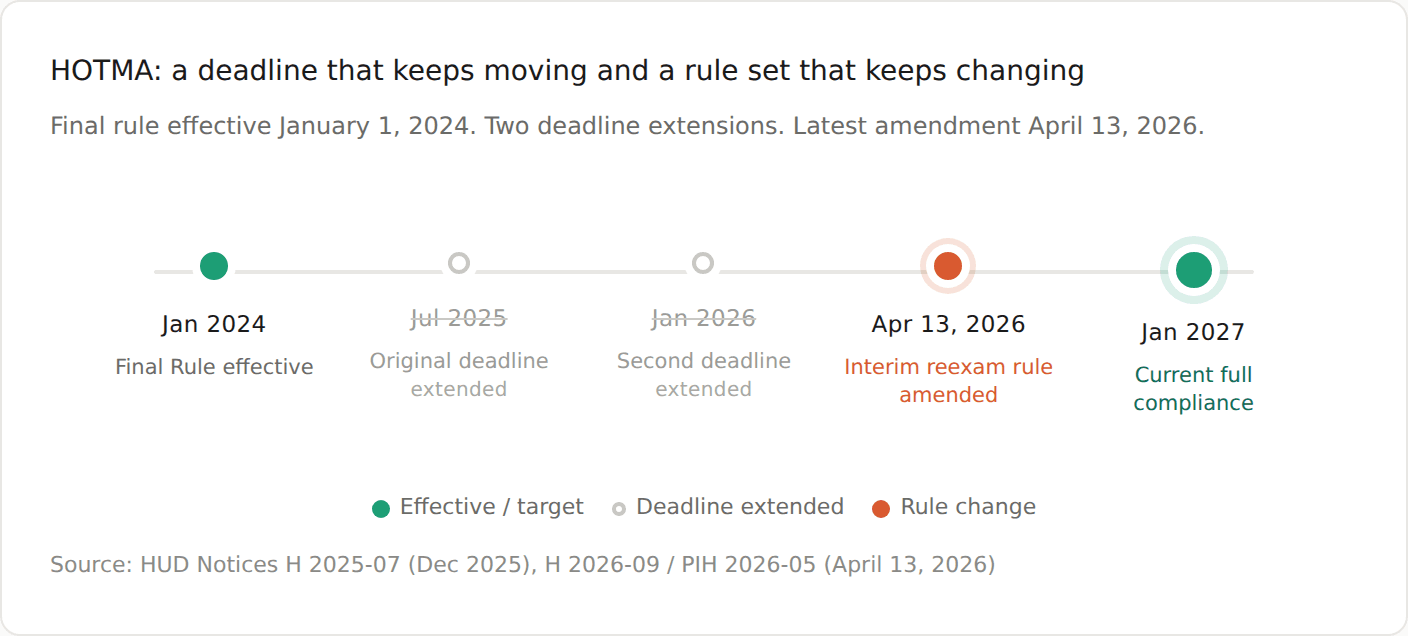
On April 13, 2026, HUD issued Notice PIH 2026-09 and Notice H 2026-05, amending the standard for interim reexaminations triggered by household composition changes. Owners and PHAs must now run an interim reexamination whenever a household adds or removes a member, regardless of whether the change affects adjusted income. That is a separate trigger from the income-based interim reexam threshold. As Navigate Housing put it the next day, teams need to update policies, retrain staff, and revise checklists now (Navigate Housing, April 14, 2026).
Grace Hill has rebuilt its entire Tax Credit Basics curriculum around HOTMA; all 17 courses now carry the HOTMA designation (Grace Hill catalog, 2026). The updated course list itself is the tell: compliance is no longer back-office administration.
The talent bottleneck
The pipeline expansion and the compliance overhaul are colliding with a labor market that was already tight.
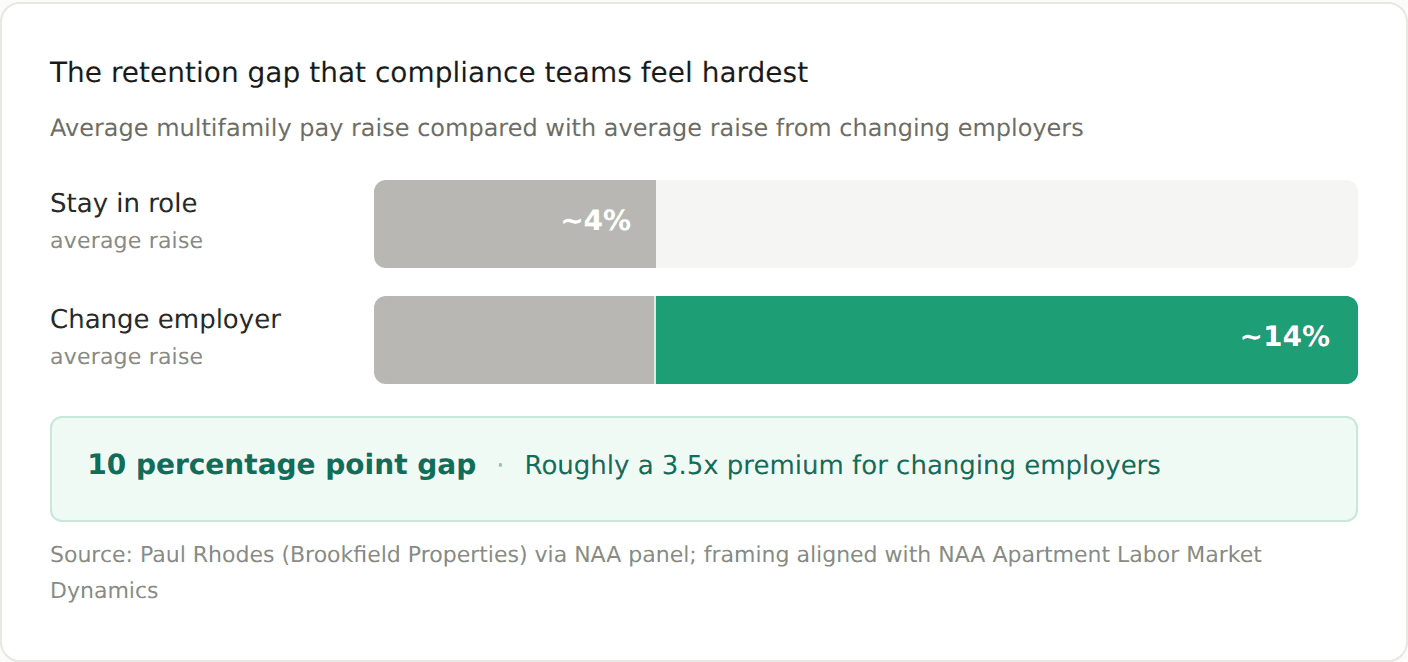
Three pressures stack. First, the experienced affordable-housing compliance bench is thin, and broader property-management labor data shows the industry is not producing replacements quickly enough. NAA's Voice of the Property Manager 2024 survey found that 23% of property managers expect there will be fewer property managers in the industry within five years. Second, internal compensation is not keeping pace with external offers. Brookfield's Paul Rhodes told an NAA panel that the average multifamily raise is roughly 4% while the average job-change raise is roughly 14%. Third, hiring narrowed even before the OBBBA pipeline arrived. NAA's Q1 2025 Apartment Labor Market Dynamics report found corporate was the only multifamily category where postings grew year over year.
The audit math is what makes the scarcity expensive. Industry research cited by NCHMA finds that dedicated LIHTC compliance teams reduce audit findings by 20 to 30%. Fully affordable properties have posted roughly 7.4% NOI growth recently. A material unresolved compliance finding can put credits, investor confidence, and operating gains at risk in the same year. Compliance has stopped being overhead. It is a direct contributor to NOI.
What the skill stack looks like now
The compliance specialist profile operators want did not exist five years ago. The role is expected to be HOTMA-current rather than HOTMA-trained, with TRACS 203A fluency, working knowledge of recent HUD notices including the new zero-threshold rule on household composition changes, deep Section 42 expertise, and cross-program experience layered on top: LIHTC plus project-based Section 8 plus HOME plus PBV.
Pay has moved with the skill stack. Public salary benchmarks are noisy. PayScale shows compliance specialists in the mid-$40,000s nationally (Payscale, March 2026) on a thin sample, but multi-program compliance manager roles in major MSAs are advertising between $76,500 and $95,000. New York's HDC posted a current LIHTC compliance specialist role at $68,000 to $74,000. The market-clearing rate for layered-program compliance talent is clearly above generic compliance-specialist averages. Bonuses, retention compensation, and remote flexibility are doing more work than base.
What to do now
Texas alone has roughly $1 billion in private activity bond volume cap distributed across its issuers for 2026, and the 25% test creates capacity for roughly twice as many projects (TAAHP, April 2026). Every project will need a compliance team in place 18 to 24 months from groundbreaking. The clock has already started.
Three moves matter most.
Build the compliance team 18 to 24 months before lease-up. The construction window is now the hiring window.
Stretch the salary band. The math on a stalled certification or a failed audit beats the math on a salary concession every time.
Build a relocation pipeline. The specialists who can execute under the new HOTMA framework rarely live in the markets that need them most.
For candidates, HOTMA-current compliance has become structural leverage in multifamily, not a back-office career step. The credit expansion is permanent. The skill premium is real.
The supply side of affordable housing has its tailwind. Whether those units actually deliver depends less on the bonds and the credits and more on whether the right people are at the file cabinet on the day the auditor arrives.
—
For affordable operators staffing portfolios under the 2027 HOTMA deadline: https://www.callpercy.com/sales.