More Openings, Moving Jobs: The State of Property Management Hiring, Q4 2026

Apartment operators posted 13.7% more on-site jobs in the second quarter than a year earlier (NAA, August 2026). Payroll at the companies that own apartments fell 2.1% in the year to August, while payroll at the firms that manage them rose 1.2% (BLS, October 2026). Both are true, and together they say more than either alone. The apartment job is leaving the owner's payroll for the manager's, and leaving the desk for the breezeway.
The short version
Postings are up 13.7% and every on-site occupation grew; corporate postings fell.
Owners shed about 13,000 jobs in a year. Managers added about 10,000. The work is moving, not disappearing.
The big REITs run 10% fewer people per unit than in 2019, and the private equity firms buying fee managers expect the same.
Maintenance is where the pressure shows: pay is outrunning the economy, and nearly every bonus in a job title is a maintenance role.
The seats are fewer. The people in them matter more.
The backdrop
The supply wave is over. Developers completed nearly 318,000 units in the year to September, about 46% below the late-2024 peak near 588,000 (RealPage, October 2026). CoStar data put 2026 deliveries near 421,000, with another 24% drop in 2027 (Commercial Observer, October 2026).
Demand has nearly caught up, with occupancy at 95.4%. But one in seven stabilized units still carries a concession, and the average discount of 11.1%, about 5.8 weeks free, is the deepest in 15 years (RealPage, October 2026).
Capital is the frozen part. NMHC's debt financing index fell from 46 to 10 in a single quarter, and 81% of respondents called it a worse time to borrow (NMHC, October 2026).
That removes the growth channels. Fewer lease-ups mean fewer new teams. Frozen transactions mean fewer takeovers. Demand concentrates in stabilized operations, maintenance and replacing the people who leave.
More openings
Unique apartment job postings reached 56,716 in the second quarter, up 13.7% from a year earlier (NAA, August 2026). The growth was on site. Property and community manager postings rose 13.1%, maintenance supervisors 12.7%, leasing 12.1% and maintenance technicians 8.9%. Corporate postings fell 5.3%.

Part of that is a low base. In the third quarter of 2025 postings were falling 8.1% (NAA, December 2025). The rebound clears it: second-quarter postings two years ago were about 51,000 (NAA, August 2024), so this spring ran roughly 11% above that too.
Pay is moving with it. Advertised maintenance technician salaries grew 3.8% year over year, ahead of the 2.4% growth in posted wages across the whole economy (NAA, August 2026; Indeed Hiring Lab, October 2026).
Our own sweep reads titles, not pay, but it shows where the urgency sits. Each week we read the careers pages and job-board feeds of 630 apartment operators and keep regional and operations leadership postings as individual records. On November 2, 213 regional and area manager postings were live at 109 operators. Of the 135 with a posting date, the median had been up 33 days, and more than half for 30 days or longer.
In the job-board feed for our largest-tier operators, 60 live titles used urgency language. Forty-one advertised a bonus, and 34 of those were maintenance roles. No regional title did.
One caution applies to every number in this section. Postings count openings, not jobs. A seat refilled three times in a year is three postings and no growth.
Moving jobs
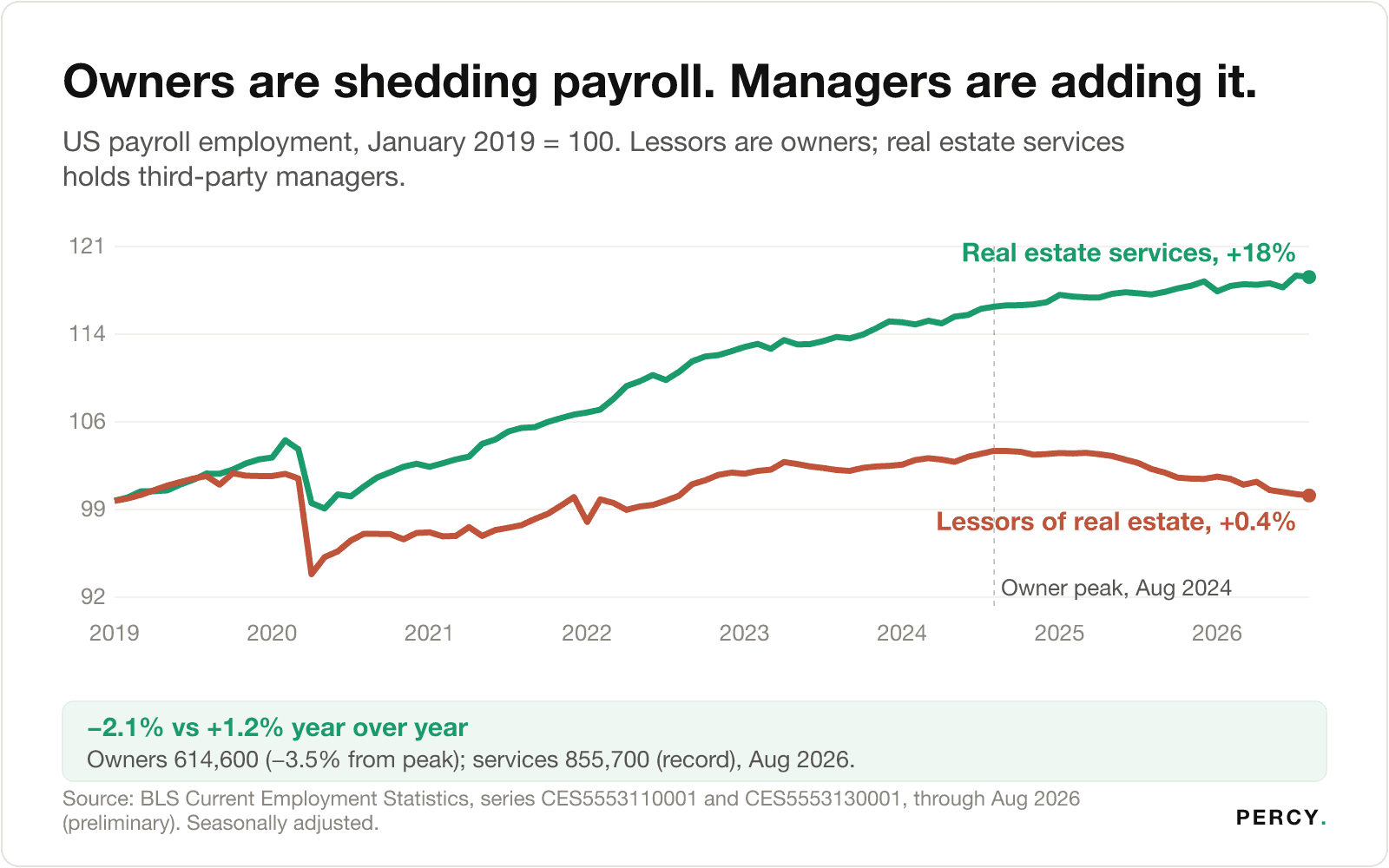
The Bureau of Labor Statistics splits real estate employment two ways, and the split is the story. Payroll at lessors of real estate, the owners, peaked at 636,900 in August 2024 and stood at 614,600 in August 2026, down 3.5% (BLS, October 2026). Payroll in real estate services, where third-party managers sit, rose 1.2% to 855,700, just below July's record.
In round numbers, owners shed 13,000 jobs in a year and managers added 10,000.
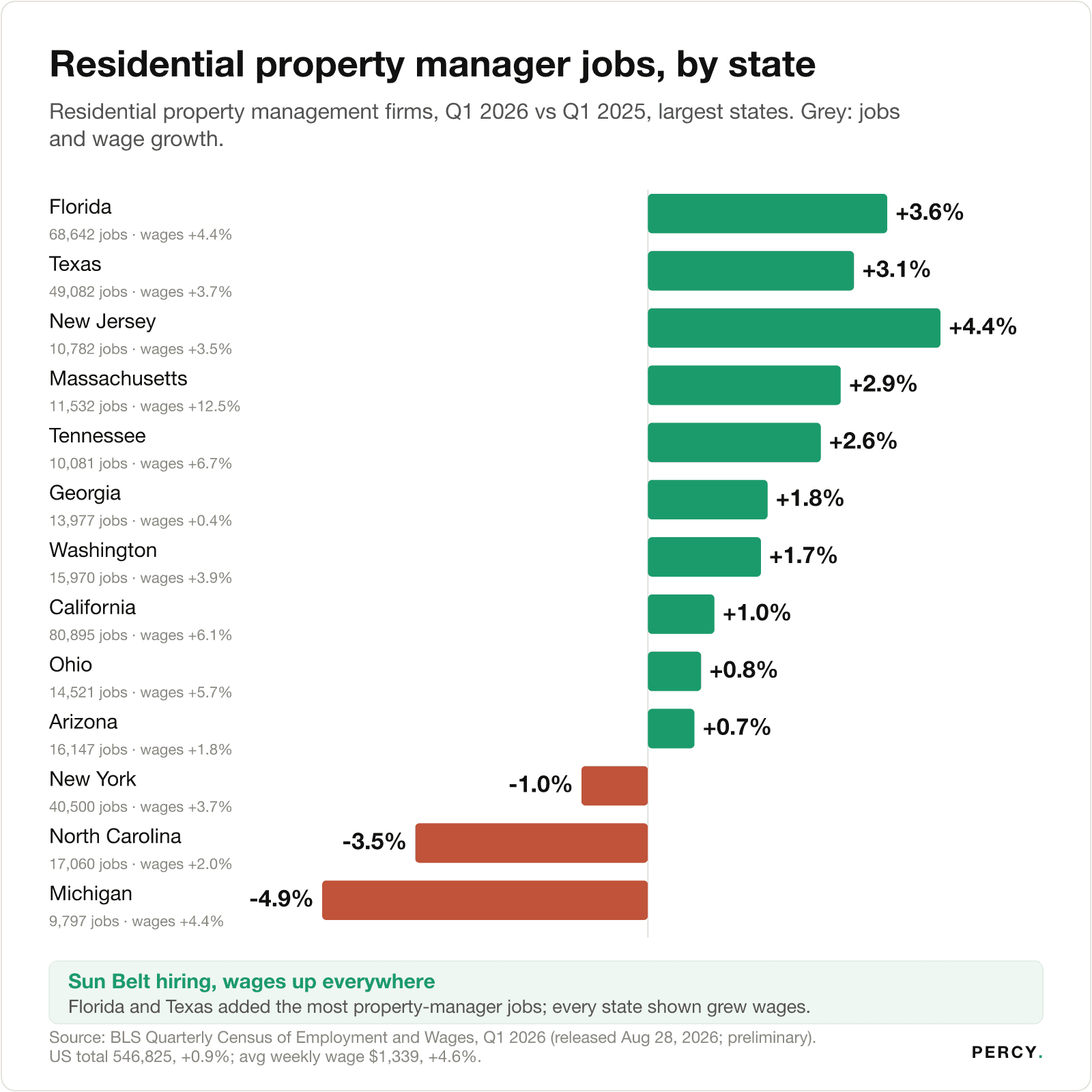
The quarterly census of employers, which counts every covered job rather than sampling, agrees one level down. Average first-quarter employment at residential property management firms rose 0.9% from a year earlier, and their average weekly wage rose 4.6% to $1,339 (BLS QCEW, Q1 2026). Employment at owners of residential buildings fell 0.7%.
The owners have said why. Vivmark, formed when Equity Residential and AvalonBay merged in August, expects $175 million in synergies, more than $45 million of it from on-site expense reductions (Vivmark at BofA conference, September 2026). Before the merger, Equity Residential described its first wave of operating changes as "about a 20% headcount reduction," with AI expected to bring "another 10 to 15%" (Equity Residential at Citi conference, March 2026).
The filings show the longer arc. Across the six largest self-managed apartment REITs, headcount reported in each year's 10-K fell 3.5% between 2019 and 2025 while the apartments they own grew 7.5% (SEC 10-K filings). Employees per thousand units fell at all six, from 30.4 to 27.3. Equity Residential went from 33.8 to 28.2 and AvalonBay from 35.9 to 30.8. MAA and Camden, which centralized earlier, moved about one point each.
Bigger buildings explain part of that, not most of it. Units per community rose between 1% and 6% at the six over the same span, while employees per thousand units fell between 3% and 17%. Essex, the one company that reports on-site staff separately, went from 24.6 on-site employees per thousand units in 2020 to 20.1 in 2025, a drop of 18% (Essex 10-K filings).

MAA told its third-quarter call that its priorities include "increased centralization and specialization," worth about $25 million in run-rate margin by the end of 2027, partly by continuing to "pod" properties (MAA, October 2026). Essex, reporting the same week, said nothing about headcount. These are self-managed owners. Their cuts land in the owner payroll series. Fee managers' site teams do not.
Then there is turnover. On-site turnover across real estate ran 29.2% in 2025, double the 14.2% corporate rate (NAA/RCLCO, April 2026). An operator with 100 communities and five on-site staff at each employs about 500 people in the field. At 29.2% it hires roughly 146 of them again every year without adding a seat.
Turnover does not explain a 13.7% jump in postings. The owner-to-manager shift, the low base and the reposting of long-open roles do the rest.
Who is buying the managers
The payroll is moving toward a group of employers that is itself changing hands. The 50 largest apartment managers ran 5,252,028 units on January 1, 2026, up 6.0% in a year, and the top ten grew 8.7% (NMHC Top 50, 2026). Asset Living, second on the list, grew from 288,665 units to 446,427 in a single year, an increase of 157,762 (NMHC, 2026).
As one industry analyst put it, most properties are now third-party managed, "and that majority is getting bigger each year" (NAA, September 2025).
Private equity has noticed. Pretium bought BH Management, with about 114,000 units and 2,800 employees (Pretium, May 2024). Alpine Investors launched Oakline Properties and assembled more than 80,000 units in under a year through Cirrus, Drucker + Falk and ResidentialOne (Alpine Investors, September 2025 to June 2026). TriSpan committed up to $100 million to roll up smaller managers under the Proper brand (PR Newswire, June 2024). CenterOak carved Village Green out of its parent (CenterOak Partners, 2025).
The stated theses are nearly identical: recurring fees, a fragmented industry, and shared services that get cheaper with scale. Roland Berger called the sector "a next-generation private equity platform play" (Roland Berger, July 2026).
For the people on site this means fewer, larger employers, and owners who expect centralization to pay back a purchase price. Retaining the site teams that come with an acquired portfolio has become an underwriting question, not an HR one.
Where the software is landing
Adoption is no longer the question. Fifty-eight percent of real estate management professionals now use AI, up from 45% a year ago and 21% in 2023 (AppFolio and IREM, September 2026). Thirteen percent expect it to shrink headcount.
Look at where the tools work. Leasing inquiries, renewals, contact centers, tour coaching, capital budgets. These are the parts of the job that happen at a desk. NAA's Performance Ecosystem survey found on-site staff spend 42% of the week on routine administration and 17% with residents (NAA, April 2026). Centralization moves the 42% to a hub.
Nobody has automated a work order, a vacant unit turn or a resident standing in the hallway at six o'clock. That is why maintenance technician postings grew 8.9% and maintenance supervisor postings grew 12.7% in the same quarter the REITs were cutting.
What this means for hiring
The on-site job is being split in two. The administrative half is leaving for hubs and software. What stays is judgment, residents and the physical asset.
For regional managers, the span is widening, for fee reasons as much as technology. A regional who ran eight communities now runs more doors, with site leads who are part specialist and part generalist, and a dashboard where the weekly call used to be.
Regional postings that sit a month or more in our sweep are tight supply or operators getting pickier about this profile. Either way the job has changed, and so has the interview. Ask a regional candidate which of their community managers is most likely to leave in the next six months, and how they know. The answer tells you whether they run people or run reports.
For maintenance, the market has already decided. Advertised pay is outrunning the economy's, bonuses are showing up in job titles, and supervisor openings are growing faster than technician openings. If your 2027 maintenance bands locked in October, plan an off-cycle adjustment for the second quarter. Expect to pay supervisors for scope they did not have two years ago.
For site leadership, hire for the job that will exist in 18 months, not the one in the current description. If a hub will take the applications and the renewals, the community manager's value is in what the hub cannot see. And if your portfolio changes hands, assume the buyer has already modeled your site headcount. The teams that keep their people through a transition are the ones that named their keepers before the deal closed.
Percy's take
Four reads for the next two quarters.
The regional seat is being redefined, not deleted. Fewer regionals will run more doors. Expect the postings to stay open longer and the profile to keep narrowing.
Maintenance pay is outrunning the general labor market. Where operators advertise a bonus in the job title, it is almost always for maintenance. Bonuses are a symptom. Pay bands are the cure.
Centralization raises the bar for whoever stays on site. The operators moving first want site leads who can run a hub-fed property: read the variance report, manage the vendors, own the residents.
Turnover is the number to manage. At 29.2%, retention beats recruiting volume. Exit surveys name pay and career paths. Candidates tell recruiters something different: the manager they reported to and the on-call rotation. Both are fixable without a budget cycle.
The seats are fewer. The people in them matter more.
What to watch next
Two of the operators quoted here report this week, and both calls are open to anyone who wants to listen.
Thursday, November 5, 1:00 p.m. Eastern. Vivmark's first earnings call as a merged company. The live audio webcast is public, and the event is on the company's investor calendar. Listen for the on-site share of the $175 million synergy target and any update to the "20%" headcount figure.
Friday, November 6, 10:00 a.m. Central. Camden's third-quarter call, on Camden's investor site or by dial-in at (888) 317-6003, passcode 1517857. Camden centralized early; listen for whether it sees further room.
December 2. The Bureau of Labor Statistics releases second-quarter census employment and wage data, which will update the property manager figures above.
December. The NAA's third-quarter labor report.
If any of the four changes the picture, it is the kind of thing we would want to write about.
Notes on the numbers
Every figure in this piece can be checked. The employment and wage data come from the Bureau of Labor Statistics, the headcounts from the companies' own 10-K filings, the quotes from earnings call transcripts, and the posting counts from the National Apartment Association. Each is cited in the text with its date. Where a number is a vendor's claim, we say so.
—
Percy recruits regional managers, community managers, maintenance supervisors and maintenance technicians for conventional, affordable and student housing operators. If your 2027 staffing plan assumes a smaller, more senior on-site team, we should talk.